

Introduction: From Gold Investment to Active Trading
Gold has long been associated with long-term wealth preservation, portfolio stability, and protection against systemic risk. Traditionally, investors accessed gold through physical bullion, coins, or long-term holdings such as gold ETFs. However, modern financial markets have expanded gold’s role beyond passive investment. Today, gold is also one of the most actively traded instruments on the Forex market, primarily through the XAU/USD currency pair.
- Introduction: From Gold Investment to Active Trading
- What Is XAU/USD?
- Why Gold Is Popular on the Forex Market
- What Drives XAU/USD Price Movements?
- Gold Trading vs Gold Investing: Key Differences
- How Gold Is Traded on Forex Platforms
- Common Gold Trading Strategies
- Volatility: Opportunity and Danger
- Understanding Leverage in Gold Trading
- Risk Management: Essential for XAU/USD Trading
- Who Should Trade Gold on Forex?
- Gold’s Role in an Active Portfolio
- Conclusion: Gold on Forex as a Tactical Instrument
For active traders and short-term investors, gold trading on Forex represents a fundamentally different approach compared to traditional gold investment. Instead of buying and holding gold as a store of value, traders seek to profit from price movements, volatility, and macroeconomic reactions that unfold over minutes, hours, or days. This transition—from investing to trading—marks a shift not only in strategy, but also in mindset, risk profile, and required expertise.
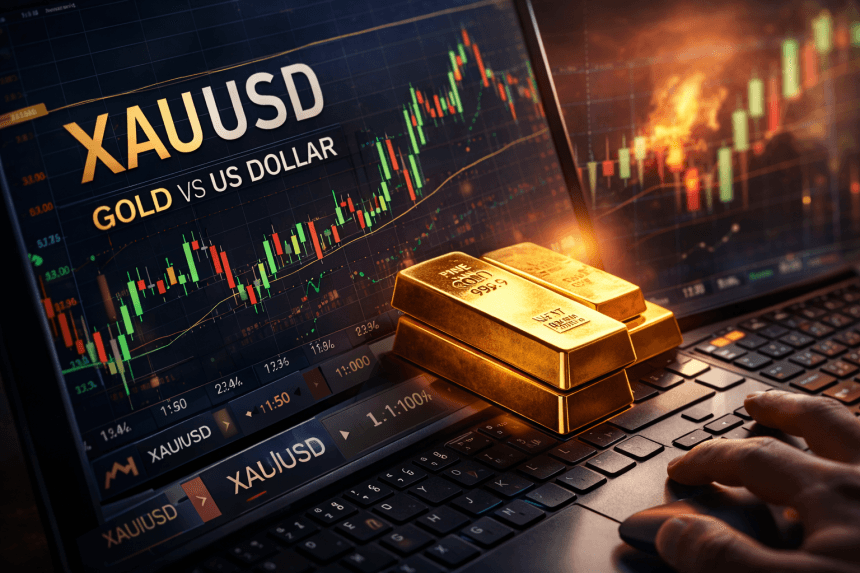
XAU/USD, which represents the price of one troy ounce of gold quoted in U.S. dollars, is among the most liquid and widely followed commodities in global markets. It reacts sharply to inflation data, interest rate decisions, geopolitical tensions, currency fluctuations, and changes in investor sentiment. As a result, gold often provides more trading opportunities than many currency pairs, especially during periods of economic uncertainty.
This article serves as a bridge between traditional gold investing and active trading strategies. It explains what XAU/USD is, why it moves the way it does, how Forex gold trading differs from long-term investing, and—critically—the risks associated with leverage. Designed for traders and active investors, this guide provides a structured, expert-level introduction to trading gold online via the Forex market.
What Is XAU/USD?
XAU/USD is the standard ticker symbol used in financial markets to represent gold priced in U.S. dollars.
- XAU = one troy ounce of gold
- USD = U.S. dollar
When traders buy or sell XAU/USD, they are speculating on whether the price of gold will rise or fall relative to the dollar.
Why Gold Is Quoted Against the U.S. Dollar
Gold is globally priced in U.S. dollars because:
- The U.S. dollar is the world’s primary reserve currency
- Most international commodity markets settle in USD
- U.S. monetary policy strongly influences gold prices
This creates a natural inverse relationship between gold and the dollar: when the dollar weakens, gold often rises, and vice versa—though this relationship is not perfectly linear.
Why Gold Is Popular on the Forex Market
Gold occupies a unique position on Forex platforms. While technically a commodity, it trades alongside currency pairs and shares many of their characteristics.
Key Reasons Traders Choose XAU/USD
- High liquidity across global sessions
- Strong volatility, especially during news events
- Clear macroeconomic drivers
- Tight spreads on major Forex brokers
- Availability of leverage
For active traders, gold offers more pronounced intraday movements than many major currency pairs, making it attractive for both technical and fundamental strategies.
What Drives XAU/USD Price Movements?
Understanding what moves gold prices is essential for successful gold trading on Forex. Unlike equities, gold does not generate earnings or dividends. Its price is driven almost entirely by macroeconomic and psychological factors.
1. Interest Rates and Monetary Policy
Gold has no yield. As a result:
- Rising interest rates increase the opportunity cost of holding gold
- Falling or stable rates tend to support gold prices
Decisions and forward guidance from the Federal Reserve are among the most powerful drivers of XAU/USD.
2. Inflation and Real Yields
Gold is highly sensitive to real interest rates (nominal rates minus inflation):
- Negative real yields are bullish for gold
- Falling inflation expectations can pressure gold prices
Inflation reports such as CPI and PCE are closely watched by gold traders.
3. U.S. Dollar Strength
Because gold is priced in USD:
- A stronger dollar generally weighs on gold
- A weaker dollar supports gold prices
Many traders analyze gold in parallel with the DXY (U.S. Dollar Index).
4. Geopolitical Risk and Market Stress
Gold is a classic safe-haven asset:
- Wars, sanctions, and political instability often trigger gold buying
- Financial crises increase demand for gold as a risk-off asset
During such periods, gold can move independently of traditional correlations.
5. Market Sentiment and Positioning
Gold is heavily traded by:
- Hedge funds
- Central banks
- Institutional speculators
Positioning data (e.g., COT reports) can influence short- to medium-term price action.
Gold Trading vs Gold Investing: Key Differences
One of the most important distinctions for market participants is the difference between investing in gold and trading gold on Forex.
Gold Investing
- Long-term horizon (years)
- Focus on capital preservation
- Typically involves physical gold or ETFs
- Lower transaction frequency
- Minimal leverage
Gold Trading on Forex
- Short- to medium-term horizon (minutes to weeks)
- Focus on price movements and volatility
- Uses derivatives (CFDs or spot contracts)
- High transaction frequency
- Often involves leverage
Key takeaway:
Gold investors think in terms of cycles and purchasing power. Gold traders think in terms of momentum, levels, and catalysts.
How Gold Is Traded on Forex Platforms
On Forex platforms, gold is typically traded as a CFD (Contract for Difference) or spot instrument.
Characteristics of Forex Gold Trading
- No physical delivery
- Cash-settled contracts
- Ability to go long or short
- Margin-based trading
This structure allows traders to profit from both rising and falling gold prices—but it also introduces leverage-related risk.
Common Gold Trading Strategies
1. Trend Trading
Gold often develops strong, sustained trends driven by macroeconomic themes.
- Traders follow higher highs and higher lows (uptrends)
- Or lower highs and lower lows (downtrends)
- Moving averages and trendlines are commonly used
2. News-Based Trading
Gold reacts sharply to:
- Inflation releases
- Interest rate decisions
- Central bank speeches
This strategy requires speed, discipline, and strict risk control.
3. Range Trading
During periods of macro uncertainty, gold may trade within defined ranges.
- Traders buy support and sell resistance
- Works best in low-volatility environments
4. Breakout Trading
Gold frequently consolidates before major moves.
- Traders enter when price breaks key technical levels
- Often combined with volume and volatility indicators
Volatility: Opportunity and Danger
Gold is known for its sharp intraday moves, sometimes exceeding 1–2% in a single session. For traders, this volatility is both an opportunity and a threat.
- Volatility creates profit potential
- But it also increases stop-loss risk
- Slippage can occur during fast markets
Gold is not a beginner-friendly instrument without proper preparation.
Understanding Leverage in Gold Trading
Leverage is one of the defining features—and biggest risks—of Forex gold trading.
How Leverage Works
Leverage allows traders to control a large position with a small amount of capital. For example:
- 1:20 leverage means $1,000 controls $20,000 of gold
- A 1% move becomes a 20% gain—or loss—on capital
Risks of Leverage
- Losses are magnified
- Emotional pressure increases
- Margin calls can force liquidation
- Small mistakes become costly
Many traders lose money not because they are wrong about direction, but because leverage amplifies normal market noise.
Risk Management: Essential for XAU/USD Trading
Successful gold traders prioritize risk management over prediction.
Core Risk Management Rules
- Use conservative leverage
- Risk only 1–2% of capital per trade
- Always use stop-loss orders
- Avoid overtrading during high-impact news
- Respect gold’s volatility
Gold rewards discipline—and punishes overconfidence.
Who Should Trade Gold on Forex?
Gold trading is best suited for:
- Experienced Forex traders
- Active investors with macro knowledge
- Traders comfortable with volatility
- Those who can manage leverage responsibly
It is not ideal for:
- Passive investors
- Beginners without risk management skills
- Investors seeking long-term wealth storage
Gold’s Role in an Active Portfolio
For active investors, gold can serve two functions:
- A trading instrument for short-term opportunities
- A macro hedge during periods of instability
Some traders combine long-term gold investments with short-term XAU/USD trades, separating capital and objectives.
Conclusion: Gold on Forex as a Tactical Instrument
Gold trading on Forex transforms gold from a defensive asset into a dynamic trading instrument. Through XAU/USD, traders can capitalize on gold’s sensitivity to inflation, interest rates, currency movements, and geopolitical events. However, this opportunity comes with significant risk—particularly from leverage and volatility.
Understanding the difference between investing in gold and trading gold is essential. Forex gold trading is not about owning gold; it is about managing risk, timing, and market psychology.
For disciplined traders with a clear strategy and strong risk controls, XAU/USD can be one of the most powerful and versatile instruments in the Forex market. For others, gold may be better left in its traditional role—as a long-term anchor rather than a short-term weapon.