


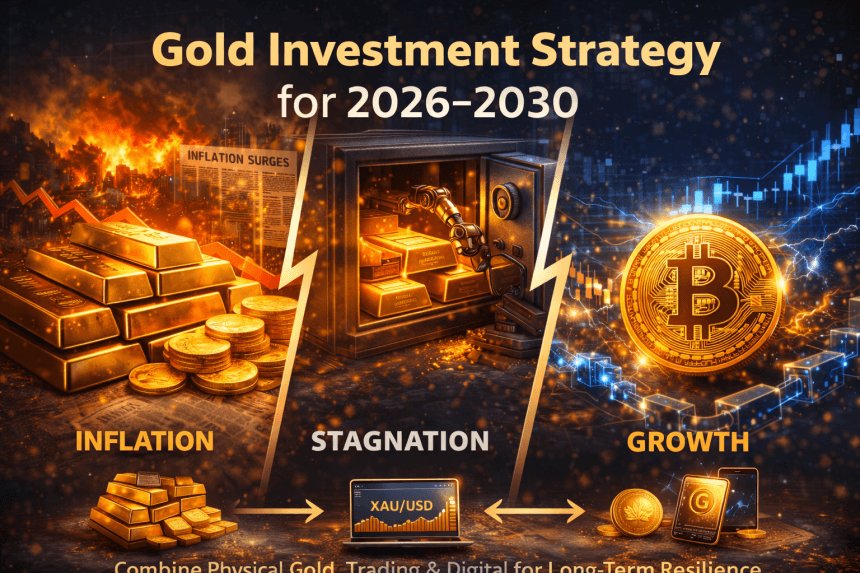
Introduction: Why 2026–2030 Requires a Different Gold Strategy
The period from 2026 to 2030 is shaping up to be one of structural uncertainty rather than cyclical normality. Unlike previous decades, investors are no longer dealing with a single dominant macro theme. Instead, they face overlapping risks: persistent inflation pressure, record sovereign debt, geopolitical fragmentation, technological disruption, and shifting monetary regimes.
- Introduction: Why 2026–2030 Requires a Different Gold Strategy
- Gold’s Strategic Role in the 2026–2030 Macro Landscape
- Scenario-Based Thinking: The Core of a 2026–2030 Gold Strategy
- Scenario 1: Persistent Inflation (The “Slow Burn” Scenario)
- Scenario 2: Stagnation and Financial Repression
- Scenario 3: Economic Growth with Currency Debasement
- Core Components of a 2026–2030 Gold Strategy
- Layer 1: Physical Gold — The Strategic Foundation
- Layer 2: Gold on Forex (XAU/USD) — Tactical and Adaptive Layer
- Layer 3: Digital and Tokenized Gold — Liquidity and Modern Access
- Putting It Together: Sample Gold Allocation Models
- Risk Distribution: The Hidden Strength of Gold Strategies
- Common Strategic Mistakes to Avoid (2026–2030)
- Gold as a Strategic Asset, Not a Prediction
- Long-Term Monitoring and Rebalancing
- Conclusion: Building a Gold Strategy That Survives the Unknown
In this environment, gold is not just an asset—it is a strategic instrument. But the way gold is used must evolve. Simply “buying gold and holding it” is no longer sufficient for sophisticated investors, high-net-worth individuals (HNWI), or family offices seeking both protection and adaptability.
The key challenge for 2026–2030 is not predicting the future perfectly, but building a gold investment strategy that survives multiple futures:
- Inflation that refuses to disappear
- Long periods of stagnation or financial repression
- Renewed economic growth combined with currency debasement
This article is a final, strategic blueprint. It explains how to construct a resilient gold strategy using:
- Physical gold for sovereignty and long-term protection
- Gold trading (Forex / XAU/USD) for tactical adaptation
- Digital and tokenized gold for liquidity and modern financial integration
The focus is not speculation. It is risk distribution, role clarity, and scenario-based planning—the hallmarks of serious long-term investing.
Gold’s Strategic Role in the 2026–2030 Macro Landscape
Before building a strategy, it is critical to understand why gold remains structurally relevant over the next five years.
Structural Forces Supporting Gold
- Debt saturation
Global public and private debt levels make a return to “normal” interest rates difficult without triggering systemic stress. - Monetary expansion by necessity
Even in growth scenarios, governments are incentivized to inflate away debt burdens. - Geopolitical fragmentation
Supply chains, trade blocs, and currency systems are becoming less unified. - Erosion of trust in financial intermediaries
Banking stress and regulatory uncertainty increase demand for assets outside the credit system.
Gold thrives not because it is exciting—but because it is structurally antifragile in unstable systems.
Scenario-Based Thinking: The Core of a 2026–2030 Gold Strategy
A professional gold strategy does not bet on one macro outcome. It prepares for several plausible scenarios simultaneously.
We will analyze three dominant scenarios and how gold behaves in each.
Scenario 1: Persistent Inflation (The “Slow Burn” Scenario)
Characteristics
- Inflation stabilizes above historical norms (3–6%)
- Real interest rates remain low or negative
- Purchasing power erosion continues gradually
- Assets inflate, but unevenly
Gold’s Role in This Scenario
Gold historically performs well when:
- Inflation outpaces interest rates
- Confidence in fiat currency weakens slowly
- Investors seek purchasing power preservation
In this environment, gold acts as a long-duration inflation hedge, not a short-term trade.
Strategic Allocation Implications
- Higher strategic allocation to physical gold
- Reduced reliance on timing or trading
- Focus on long-term holding and accumulation
Scenario 2: Stagnation and Financial Repression
Characteristics
- Low growth or rolling recessions
- Heavy government intervention
- Controlled interest rates
- Subtle capital controls and regulation
- Limited real returns in traditional assets
Gold’s Role in This Scenario
This is historically one of gold’s strongest environments.
Why?
- Savings are punished
- Bonds underperform in real terms
- Equities struggle to generate real growth
- Capital seeks “silent protection”
Gold becomes a store of optionality—quiet, liquid, and politically neutral.
Strategic Allocation Implications
- Emphasis on sovereign assets (physical gold)
- Diversified storage jurisdictions
- Reduced counterparty exposure
- Gold as a “shadow reserve” within the portfolio
Scenario 3: Economic Growth with Currency Debasement
Characteristics
- Nominal growth returns
- Asset prices rise
- Technological optimism
- Continued deficit spending
- Gradual currency debasement masked by growth
Gold’s Role in This Scenario
Gold may underperform equities in nominal terms, but it still:
- Preserves purchasing power
- Protects against sudden policy shifts
- Acts as a volatility dampener
In this scenario, gold is not the star—but it is the risk manager.
Strategic Allocation Implications
- Moderate gold allocation
- More emphasis on liquidity and flexibility
- Tactical use of gold trading
- Integration with growth assets
Core Components of a 2026–2030 Gold Strategy
A modern gold strategy should not be monolithic. It should be layered, with each layer serving a different function.
Layer 1: Physical Gold — The Strategic Foundation
Purpose
- Capital preservation
- Systemic risk hedge
- Sovereignty and independence
- Intergenerational wealth transfer
Why Physical Gold Is Non-Negotiable
Physical gold:
- Has no counterparty risk
- Does not depend on markets or technology
- Cannot be diluted, printed, or frozen easily
- Has survived every monetary regime in history
For HNWI and serious investors, physical gold is not an investment idea—it is a balance sheet anchor.
Recommended Allocation (2026–2030)
- 40–60% of total gold exposure
- Stored across:
- Secure private vaults
- Select jurisdictions
- Limited home access (for liquidity/emergency)
Format Preference
- Investment-grade coins (liquidity)
- Recognized bars (efficiency)
- Avoid collectibles or speculative formats
Layer 2: Gold on Forex (XAU/USD) — Tactical and Adaptive Layer
Purpose
- Respond to macro events
- Hedge other portfolio risks
- Profit from volatility
- Short- to medium-term positioning
Important Distinction
Gold trading is not gold ownership.
It is a risk management and tactical instrument.
Why Include Trading at All?
Between 2026 and 2030:
- Policy shocks will be frequent
- Volatility will spike unpredictably
- Macro narratives will shift quickly
A controlled trading allocation allows investors to:
- Hedge downside in other assets
- Reduce exposure during gold corrections
- Monetize volatility without selling core holdings
Recommended Allocation
- 10–20% of total gold exposure
- Strict risk controls
- Low leverage or none
- Separate capital pool from long-term holdings
Who Should Use This Layer
- Experienced investors
- Those with professional risk discipline
- Investors who understand drawdowns and leverage risks
Layer 3: Digital and Tokenized Gold — Liquidity and Modern Access
Purpose
- Liquidity
- Fractional access
- On-chain integration
- Cross-border mobility
Why Digital Gold Matters in 2026–2030
As finance becomes more digital:
- Liquidity matters as much as ownership
- Speed of transfer becomes strategic
- Some capital must live “inside the system” to function
Digital gold fills the gap between:
- Physical sovereignty
- Financial system usability
Strategic Use Case
- Collateral
- Rapid rebalancing
- Bridge between crypto, fiat, and gold
- Tactical liquidity buffer
Recommended Allocation
- 10–20% of total gold exposure
- Only fully backed, transparent structures
- Clear redemption rights
- Conservative role (not speculative)
Putting It Together: Sample Gold Allocation Models
Conservative HNWI Model
- Physical gold: 60%
- Forex gold (hedging only): 10%
- Digital gold: 10%
- Reserve for opportunistic buys: 20%
Balanced Strategic Model
- Physical gold: 50%
- Forex gold (tactical): 15%
- Digital gold: 15%
- Dynamic rebalancing buffer: 20%
Growth-Aware Model
- Physical gold: 40%
- Forex gold: 20%
- Digital gold: 20%
- Optionality reserve: 20%
These are frameworks, not prescriptions. The key is role separation.
Risk Distribution: The Hidden Strength of Gold Strategies
The biggest mistake investors make is treating gold as a single risk.
In reality, gold strategies distribute risk across:
- Form risk (physical vs financial)
- Jurisdictional risk
- Liquidity risk
- Regulatory risk
- Market risk
A layered approach reduces concentration and increases resilience.
Common Strategic Mistakes to Avoid (2026–2030)
- Treating gold as a short-term trade
- Overconcentration in one form (only ETF, only physical)
- Ignoring storage and jurisdictional diversification
- Using leverage excessively
- Confusing digital gold with speculative crypto
- Reacting emotionally to price volatility
Gold punishes impatience—but rewards discipline.
Gold as a Strategic Asset, Not a Prediction
The most important mindset shift for 2026–2030:
Gold is not a bet on collapse or inflation.
It is a non-linear hedge against uncertainty.
You do not own gold because you know what will happen.
You own gold because no one knows for sure.
Long-Term Monitoring and Rebalancing
A serious gold strategy is reviewed:
- Annually at minimum
- During major macro shifts
- When gold exceeds or falls below target allocation
Rebalancing is not market timing—it is risk hygiene.
Conclusion: Building a Gold Strategy That Survives the Unknown
Between 2026 and 2030, investors will not be rewarded for certainty. They will be rewarded for resilience, flexibility, and clarity of purpose.
Gold remains uniquely positioned to:
- Protect capital during inflation
- Preserve value during stagnation
- Stabilize portfolios during growth cycles
- Function when systems are stressed
But only when used strategically.
A modern gold strategy is not about choosing between physical, trading, or digital gold. It is about assigning each the correct role, managing risk deliberately, and accepting that uncertainty is the new normal.